
Getting Ready for Spring Grazing
In the second installment of our new series, Where’s the Grass?, we share several important tasks to accomplish before you let your animals out to graze this spring.
This is the second installment in this new series on grazing. The Winter edition of SFQ has the first installment, which can be read in the SFQ archives on the Small Farms site. My previous series, “Where’s the Beef”, which ran for several years, is also available in the archives for your perusal. That series had several grazing articles too. The focus of this edition’s article is on how to get ready for the spring grazing season. Long before you let animals out to graze, there are certain agronomic and infrastructure requirements that must be met to be successful with grazing. By the time that you read this in the month of April, you should have your pastures just about ready to go for your animals.
As mentioned in the previous article, grazing can have a tremendously positive impact on your farm’s bottom line. Grazing, however, is not free! A certain amount of money must be invested into the soil and grasses, as well as the infrastructure, consisting of fences, laneways, and watering systems. First, we must be vigilant in maintaining the quality of our pastures and will periodically need to monitor the pasture soil and add any needed inputs. We need to have the soil tested for nutrients and pH. You don’t need to test the soil every single year, but certainly every three years is a good target to aim for. All pastures need a certain amount of nitrogen, phosphorus, and potassium. Fortunately, in the grazing world we don’t need to add near the amount of inputs as does a hay field. In a hayfield, almost 100% of the plant biomass is removed every year in a series of cuttings. If nutrients are not added to make up for the draw of the hay crops, the tonnages and nutritional qualities of the hay will suffer. This too can occur in a grazing pasture, but not to the same extent. About 70% of the existing nutrients are recycled through the animals every year, and also in much of the plant biomass that remains. Nonetheless, nutrients are removed from a pasture by grazing, and they too must be replaced although not to the extent of hayfields. Additionally, most pastures need a soil pH of at least 6.2 for the nutrients in the soil to be available to the growing plants. If soil is too acid, and below 6.2, the nutrients remain locked up and are not available to the plants. So, what does all of this mean? It means that you need to take a soil test about every three years and whatever the grazing land needs in the form of fertility elements and lime must be added.

High tensile fences need strong corners and bracing. Rich Taber / CCE Chenango
OK, that’s the agronomic end of the equation. We also need to talk about which species of plants need to be in the grazing mix. The two big categories of plants are the grasses, and the legumes. The grasses, such as timothy, orchard grass, Kentucky bluegrass and several others are in that grouping. On the legume side, there’s alfalfa, red clover, white clover, and birdsfoot trefoil. The advantage of the legumes is that they can pull in nitrogen from the air whereas the grasses need to be provided nitrogen in one form or another. We will look at different grazing species in late installments of this series. Many pasture fields contain what is known as a native seedbank, where seeds may lay dormant for many years and grow when the conditions are just right. This is one way to renovate an old pasture; by providing plant nutrients and lime; an old field can be made to produce again without resorting to expensive tillage and fertility inputs.

Here’s an example of barb wire fencing, which is not used too much anymore in grazing systems. Rich Taber / CCE Chenango
One of the most important components of a grazing system infrastructure is fencing. We need permanent perimeter fencing, as well as a way of subdividing the bigger fields into smaller, more manageable grazing paddocks. There are several different types of fencing that can be used for perimeter fencing. In days of old, barb wire was commonly used. This type of fencing has slowly fallen into disuse over the years as more effective fencing methds have come along, most notably high tensile electric fencing. If you are going to be using electric fencing, whether it’s for the perimeters or for interior paddocks, you will need to learn about high impedance fence chargers, and grounding systems. Many problems with electric fences stem from grounding issues. Other forms of perimeter fencing that can be used is non-electric high tensile woven wire. Barb wire has largely fallen out of practice as far as new fence construction goes. If you find yourself on a farm that has lots of old barb wire fencing on it, you can buy a little time by stringing up a hot electrified wire in front of the old barb wire, keeping the animals away from the barb wire. You will also need to decide on which method of temporary fencing you will use to divide your pastures up into smaller rotational paddocks.
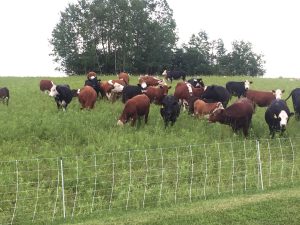
This is an example of electric netting, which can be used to subdivide pastures, but does not work well as a perimeter fence. Rich Taber / CCE Chenango
Interior paddock fencing and management is critical to the success of a rotational grazing system. The theory is simple; graze for short periods and then rest the paddocks for an appropriate number of days until the grass has grown back. The devil is in the details, and I would suggest that you purchase a good book on grazing that explains the principles of grazing and grassland management. Sarah Flack has authored an excellent publication “The Art and Science of Grazing”, which is an excellent source for grazing information. I use this book as a textbook for teaching my college students in the grazing class that I teach in the fall.
We certainly cannot forget about water in a grazing system. Sometimes you can rely on natural sources such as ponds and streams, but most of the time you will need water pumped from wells into watering troughs. You will also need to figure out how to get water to the animals in all of their grazing paddocks throughout the grazing season.
Probably the biggest challenge in a grazing system is managing the supply of grass throughout the season. In the early part of the season, we usually have more grass than we know what to do with. Once grass growth starts slowing down in the summer, it becomes a challenge to always have enough grass for the animals, and we will need to lengthen out our grazing intervals, from the 20 or so days use earlier in the season to as much as 40 days in the middle of the summer. We must avoid overgrazing at all costs! If we overgraze, we are shortchanging the animals, the grass, and our profitability.