
Futuro en Ag Team Wraps Up Ambitious Season of Farmer Education
Puede leer este artículo en español a https://smallfarms.cornell.edu/2026/01/equipo-de-futuro-en-ag-concluye-productiva-temporada-de-educacion-para-agricultores/
The team led five bilingual Farm Field Days from Central New York to Long Island, hosted a monthly cohort-based Farm Field School in the Hudson Valley, and ran a hybrid course on collaborative agriculture.
On a hot August day in the Hudson Valley, farmers and farm employees gathered at picnic tables under a stand of trees. The lunch break during this bilingual farm field day lent itself to informal conversation among participants.
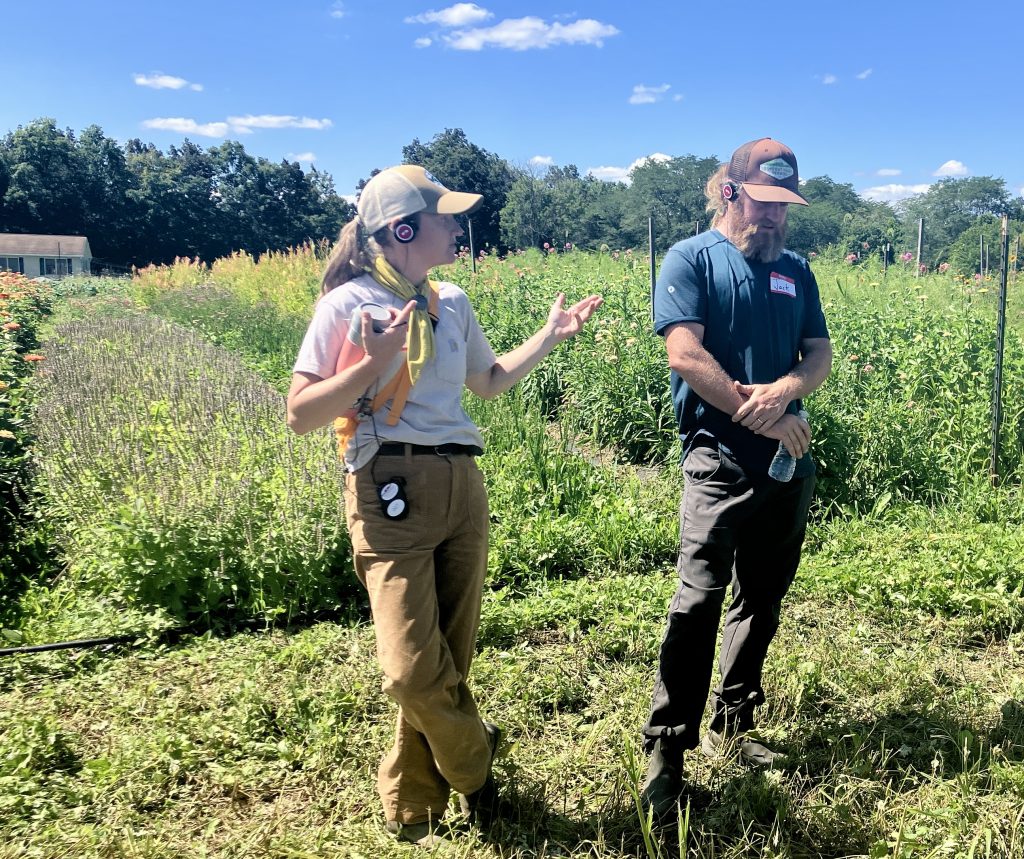
Hidden Acre: Melissa Phillips and Jack Whettam, owner-operators of Hidden Acre Farm in Bloomingburg, NY, welcomed two dozen farmers to a bilingual farm field day on their five acres of intensive vegetable and flower production in August.
Courtesy of Cornell Small Farms Program
“Pay attention to everything that’s being said here,” an older farmer advised some of the younger participants. “Now’s the time for you to be thinking about your future. It’s not just about going to work every day: think about a business you could start little by little as you work your other job.”
The younger guys nodded and took in the advice.
“Save up, start your own farm,” the older farmer continued. “You’re still young – you can afford to try something new and start over if you mess it up,” he laughed.
Cornell Small Farms Program’s Futuro en Ag team wrapped up a productive season of education. The team led five bilingual Farm Field Days from Central New York to Long Island, hosted a monthly cohort-based Farm Field School in the Hudson Valley, and ran a hybrid course on collaborative agriculture.
Participants came from many different backgrounds and are involved in a variety of farm enterprises and businesses related to diverse aspects of the food system. They hold common commitments to family and cultural traditions, share a hunger for best practices in agricultural education, and have a love for the land and the abundance it can produce.
“My father taught me that Mother Earth belongs to God,” one farmer noted. “So we can feel at home on the land wherever we are. Our responsibility in this life is to be good stewards of the earth.”
Farm field days
Futuro en Ag’s field days focused on different aspects of farming in New York State: livestock and vegetable production, market access, weed and pest management, growing in high tunnels, postharvest strategies, and more.
Institutional partners such as Glynwood Center for Regional Food and Farming and technical staff from Cornell Integrated Pest Management and Cornell Cooperative Extension (CCE) offices around New York State lent their expertise and helped to make the events successful.
Farmers in Tompkins, Orange and Schuyler Counties welcomed the agricultural community to their farms for training and hands-on demonstrations, and Futuro en Ag partnered with the CCE office in Suffolk County to host a field day at the Long Island Horticultural Research and Extension Center in Riverhead, NY.
Beyond the technical skills acquired, a central component of the field days is the consistent opportunity to build community across diverse sectors in New York agriculture. Experienced farmers share knowledge with beginning farmers, and aspiring farmers get a chance to hear how others got their start.
Hudson Valley Farm Field School
In 2025 the Futuro en Ag team put into practice a methodology common in Central America, a cohort-based Farm Field School. This approach brings farmers from the same region together regularly to build connections and address common issues and challenges the farmers face in their operations.
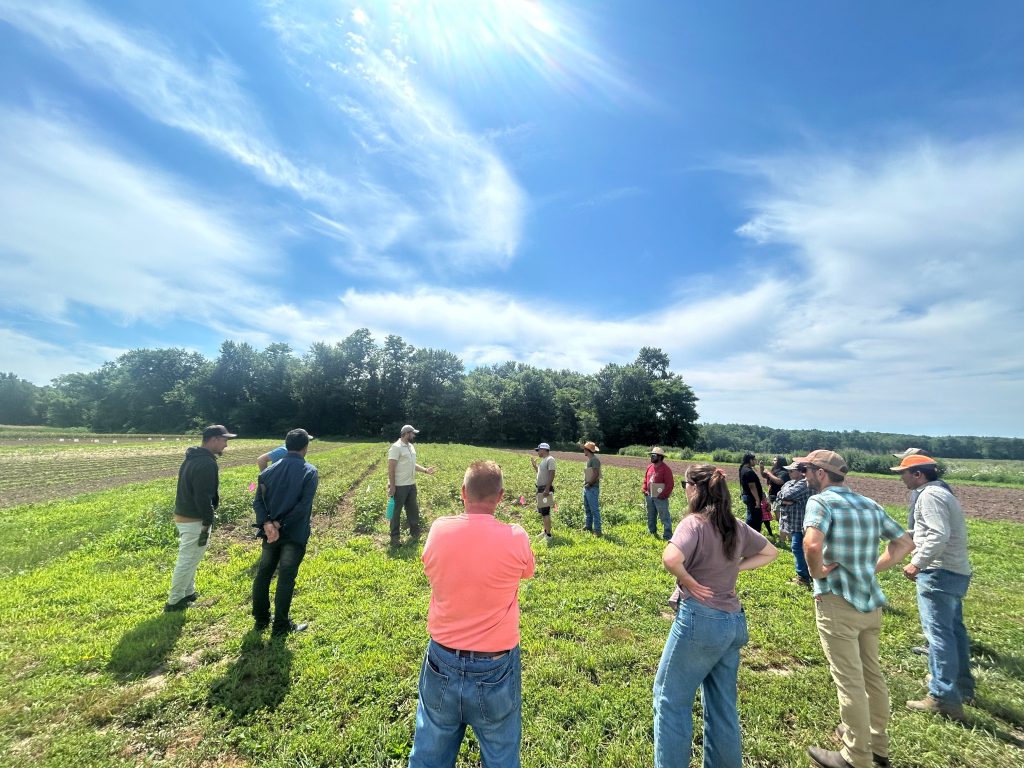
Participants in the Futuro en Ag Farm Field School visited the Hudson Valley Farm Hub in Hurley, NY to learn about a range of pest management strategies.
María José Oviedo / Cornell Small Farms Program
Mildred Alvarado, leader of the Futuro project, explained the Farm Field School model. “In our countries, technical experts and extension associates work much more with cohort groups of producers than one-on-one with farmers,” she said. “We get people together regularly to learn techniques and practices that will benefit everyone in a given region. The Farm Field School is a methodology based on learning while doing. Instead of traditional classroom learning, farmers meet in the field to observe, experiment, and analyze real issues together related to their farms. This is practical and participatory learning that’s useful for building collective capacity and solving common problems.”
Based on the farmers’ interests, the Futuro en Ag team and their collaborators established an informal research plot to test several forms of weed management. The project focused on tarping, a method of stretching plastic tarps over beds into which seeds or seedlings will be planted in order to control weed growth without chemicals.
Throughout the Farm Field School, the group carried out several comparative experiments so that the farmers could see differences among the color and weight of the tarps. The team also used complementary manual tools to help with managing the beds before and after tarping.
This practical approach allowed field school participants to see which type of tarp worked best in different conditions, and how the technique may reduce labor time spent on weeding and soil preparation, in a natural and non-invasive way.
Alvarado was pleased with the experience of this first year. “We have to thank the farmers first of all for their commitment to this process. It’s not easy to take days out of the height of the growing season to do anything that’s not directly on your own farm,” she said. “And second, we have appreciated the enthusiasm and expertise of the instructors. Everyone has made this experience a priority.”
Training farmers in collaborative agriculture
Another aspect of Futuro en Ag’s work has been responding to farmers’ interest in learning more about collaborative models for farm business management. On Long Island, in New York City, in the Hudson Valley, and in Western New York, collaborative farming projects are taking shape. Farmers seek assistance in everything from legal structures to business planning to funding for equipment and infrastructure.
“Most people starting out in farming today are keenly aware of the many barriers to entry into the industry if they want to start a farm as an individual or a family,” Alvarado said. “So there is great interest in learning how to pool their limited time and resources in a group. In that way the collaborative model is very appealing.”
The Futuro en Ag team has begun its own education being mentored by experts in the realm of ag cooperatives. Dr. Todd Schmit, Cornell University professor, and Nicole Tommell, director of the Cornell Cooperative Enterprise Program, have been instrumental in sharing their knowledge and institutional connections to build this area of work.
Futuro en Ag has developed a course of study for those aspiring to do collaborative agriculture. A central component of the instruction has focused on the business side, helping farmers to develop a collective mission and vision, and from there developing a business plan with production benchmarks and market analysis. A group of Schmit’s undergraduate and graduate students did baseline research in the spring semester that the team will build on as the business planning progresses.
One participant in the course, José Antonio, was appreciative. “We always come away from these classes better prepared to take the next step in building our cooperative,” he said.
Fall and winter offerings
In the fall, the Futuro team held its monthly bilingual farmer-to-farmer learning circle, Juntos Aprendemos, and collaborated on a two-day hands-on Tractor Maintenance and Safety training with the CSFP Farm Ops team. In addition, the team led a six-week Spanish-language online course, “Cómo Iniciar su Negocio Agrícola” with 66 participants, and is preparing for additional online offerings.
To connect to the Futuro community and find out about upcoming events, go to smallfarms.cornell.edu/projects/futuro or call, text, or write to the team on WhatsApp at 607-793-4969