
More Than Maple: Cornell Research Designs Sugarbush Agroforestry Systems
The Cornell Maple Program is growing 18 species of perennial fruit- and nut-bearing plants within a maple sugarbush forest. They want to help maple producers be more resilient to economic challenges and extreme weather events, and offer unique products like maple-elderberry wine and maple-hazelnut spreads.
Virtually all of the world’s maple syrup is produced in Canada, the Northeast U.S. and some upper Midwestern U.S. states, where natural conditions for maple sugaring are perfect: wet summers, cold winters and springs with fluctuating temperatures above and below freezing. The same environmental conditions that support maple trees also produce a host of fruits, nuts and berries, like pawpaws, juneberries and hazelnuts.

The sap from sugar and red maples flows abundantly at Arnot Forest on a sunny morning in March. Anja Timm / Cornell CALS
The Cornell Maple Program seeks to combine these natural treasures. Aaron Wightman ’97, co-director of the maple program is leading a multi-year study on growing high-value fruit and nut species within the 350-acre maple sugarbush in Cornell’s Arnot Forest. Such agroforestry systems – in which producers collect forest products and grow agricultural crops simultaneously – can increase farming efficiency and profitability, diversify crop offerings and strengthen business resilience. To support producers, the maple program is also developing and testing distinctive products like maple-elderberry wine, maple-pawpaw ice cream and maple hazelnut spreads.
“There’s been a huge increase in demand for products that are locally grown, all natural and made with ingredients that customers recognize,” Wightman said. “We wanted to develop more products from a diversified set of crops that would stand out in the marketplace, bring people to these farms and help New York maple businesses be profitable.”
Maple syrup production in New York has flourished in recent years, driven by consumer demand and improved technology (sap once collected in buckets and boiled has been replaced by forest-wide plastic tubing and reverse osmosis machines). In 2024, the state’s maple production reached 846,000 gallons, up almost 100,000 gallons from just the year before.
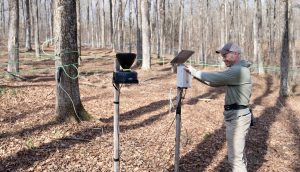
Aaron Wightman with the Cornell Maple Program, is making his rounds to check on equipment and sap lines in the sugarbush at Arnot Forest. Anja Timm / Cornell CALS
Over the past three years, the maple program has conducted performance trials with multiple varieties of 18 species of fruit- and nut-bearing perennial plants. They evaluated plant performance by assessing growth and vigor and documenting disease, stress and damage. Researchers chose plant crops that are known to grow well in shade, that can grow with minimal input from farmers and that would pair well with maple syrup in new products, said Ailis Clyne ’17, maple technician.
“We chose crops that should do well in these soil and climatic conditions in a Northeast forest and that are growing in popularity among more adventurous consumers,” she said.
For example, Clyne wanted to develop a maple wine that incorporated a forest-grown fruit, so she chose to pair maple with elderberry, a native fruit that grows well in the shade. Maple adds sugar and elderberry adds acids, tannins and flavor complexity – all components that consumers expect in a wine, she said. A maple hazelnut spread developed by maple program food scientist Catherine Monserrate has been especially well received among producers and consumers at farmers’ markets and maple weekends, Clyne said.
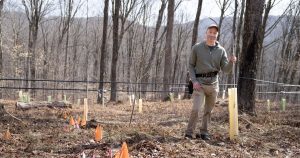
Aaron Wightman, co-director of the Cornell Maple Program at the agroforestry research plot within the maple sugarbush at Arnot Forest. Anja Timm / Cornell CALS
The initial three-year project found that the best-performing plants grown in the maple sugarbush were pawpaw, hazelnut, Cornelian cherry and aronia berry. Some varieties of juneberry performed well, too. Blueberries survived, but struggled with slow growth and defoliation. Raspberries and blackberries were not productive, were easily outcompeted by other species and had mortality rates upwards of 70%.
The research was funded by Federal Capacity Funds managed by the Cornell University Agricultural Experiment Station (Cornell AES). Established as part of President Abraham Lincoln’s land-grant university system, ag experiment stations in each state are devoted to research that improves local farming, environmental stewardship and community development. The maple program has earned another 3-year grant to continue studying their maple sugarbush agroforestry plantings and to study propagation methods for forest plants with culinary, ornamental or other value, such as bladdernut, cohosh and buckeye.
Agroforestry systems enable producers to grow more food with the same amount of land, and they help protect businesses against economically devastating crop failures by diversifying what’s being grown, Clyne said. For example, this spring’s maple harvest across New York’s Southern Tier was down by 30-50% because of drought conditions last summer and a too-warm early spring, Wightman said. Having additional crops to rely on can help producers weather bad harvests.
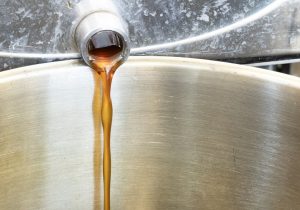
The finished maple syrup is flowing into a tank at the Arnot Forest maple lab. Anja Timm / Cornell CALS
Growing in forests also makes crops more resilient to extreme weather and helps sequester carbon.
“In forests, extreme climate conditions are moderated for us. Droughts are moderated by leaf cover overhead and deep, rich soils that retain more moisture. Flooding is moderated because forests slow surface runoff and soil erosion,” Wightman said. “At the same time, in agroforestry systems, we’re growing perennial plants that can sequester carbon instead of releasing it, and we’re producing very high-value nutrition.”
Wightman’s ambition in supporting New York maple growers comes from his desire to help rebuild communities and livelihoods in rural areas.
“Rural America is just decimated: A lot of the small farms around here have been trying to scratch out a living on these hillside farms with depleted soils, and that’s a tough fight,” he said. “But the resource base is there. We have all these highly productive forests, good markets close by and consumers interested in buying locally. I think we have the possibility of an agricultural revival in New York state that will help our rural communities and contribute real food value.”