
How Not to Graze
In the third installment of our new series, Where’s the Grass?, we share that there are many poor management practices seen in the grazing world. Here’s how to ensure you do the right things for good results!
This is the third installment in our series “Where’s the Grass?” in which we try to elaborate on the points of good grazing. Previous installments can be seen in the archives of the Small Farms Quarterly at smallfarms.cornell.edu.
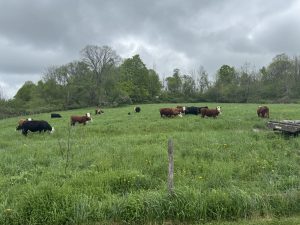
The author’s cows out on deep lush spring pasture in mid-May. The challenge in grazing is to keep pastures growing like this throughout the season. Rich Taber / CCE Chenango
As I write this article it is mid-May, and my cows have finally been put out to graze. It has been an exceedingly wet spring, and the grass took a while to start photosynthesizing due to the lack of sunlight. It is easy to be a good grazer during the month of May, but once the summer slump begins in July and August, is when we need to put our skills as good grazers to the test.
As some of you may recall from some of my previous articles, I deplore seeing animals grazing on overgrazed, depleted pastures. I see this all the time driving around the countryside, and see animals grazing on all but bare ground. Why do the animals do this? Because that is what they do. It never ceases to amaze me to see animals grazing on such pastures and they have beautiful hay waiting for them in a manger. Sooner or later, they will avail themselves of the hay but persist in grazing almost bare round because as I have alluded to, this is what animals do. They graze. So people look out upon those overgrazed pastures and see animals grazing, and they think that all is well. However, the animals are in a nutritional deficit as they are not taking in near enough dry mater intake to fuel growth, milk, and meat production. The average animals needs to take in about three pounds of forage dry matter for every one hundred pounds of body weight, so a 1200 pound cow would need about 36 pounds of forage dry matter. This translates into well over one hundred pounds of wet grass that they need to take in. On depleted pastures, they don’t take in a fraction of this needed dry matter.

Overgrazed pastures provide little or no feed for the animals. Rich Taber / CCE Chenango
So how do we prevent this from happening? This is when we use all of our skills as improved rotational grazers to provide the animals with healthy, lush growing grass throughout the season. We have to learn how to keep the animals on a grazing paddock for a few days, and then rotate them to a fresh paddock. Earlier in the season, we may be able to come back into the first paddock after as few as 21 or so days. As the season matures, we need to rest the paddocks for longer and longer intervals, depending on rain and sunshine. We may need to add some previously ungrazed paddocks that we took first cutting hay from earlier in the season. Typically dairy cows are moved into fresh paddocks every 12 hours. All other classes of animals can be held in paddocks for up to about 5 days.
Some other ways of not running a grazing program are as follows:
- Don’t ever soil test for needed fertility elements such as n-p-k and lime. Hey, as long as the grass is green everything should be ok, right?
- Don’t ever added needed inputs such as manure, fertilizer, or lime. That stuff costs money, right?
- Make your animals walk inordinate distances to get water. I’ve seen some dairy cows walking over one mile to get water. Hey, the exercise is good for them, right?
- Have an inadequate watering system. An old garden hose running into a leaky tank should be ok, right? If the cows bash into it and don’t get enough water, what’s the harm?
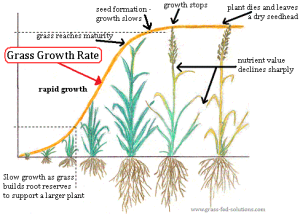
Pay attention to the growth cycles of grasses throughout the season. RIch Taber / CCE Chenango
- Have sloppy grounding situations on your electric fencing system. So what if you were told to have three ground rods, spaced every 10 feet. That old rusty single electric fence post should do as well, right? All of that fencing stuff down at the farm supply store costs money!
- If you use barb wire fencing for any of your pastures, make sure the wires remain loose, rusty, and are attached to old, broken fence posts. So what if the animals get out every once in a while?
- Why spend money on laneways? Animals can trudge through wet, swampy trails and roadways to and from the barn.
- Why bother checking your electric fences for proper charges? So what if a few branches come crashing down on your hot wire, causing shorts in the system? If you’re going to be driving around country roads, you should expect to see a few farm animals running around loose, right?
I could go on and on with my list of how not to correctly run a grazing system, but you get the point. Having a good grazing system is far more encompassing than just letting the animals out in a field in May and then collecting them up again in November. Yes indeed grazing can be less expensive than feeding stored feed, but it does take sone effort. It is not “free”, it takes a certain amount of time, money, attention and effort to have a successful grazing system in which the animals flourish. Graze away!