
Carrying Capacity
How many sheep can you raise per acre?
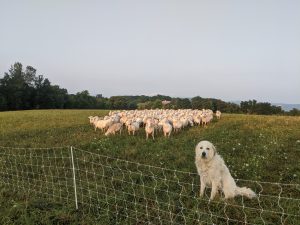
Pasture shift: a daily pasture rotation increases the carrying capacity significantly.
Ulf Kintzel / White Clover Sheep Farm
The question about how many sheep per acre one can raise is almost guaranteed to be asked when people inquire about my White Dorper breeding stock, especially when they are beginners. It also is the question that is the hardest to answer because it depends on so many different factors.
Let’s first define the term: Carrying capacity means how many sheep can be raised annually on an acre. “Sheep per acre” always addresses the ewes but also includes their lambs without specifically mentioning them. Let’s calculate an example with an average lambing percentage of 150 % or 1.5 lambs per ewe annually to give you an example: two sheep per acre means two ewes and three lambs per acre.
The carrying capacity can vary widely, depending on many different factors. Here are some examples:
Soils
The fertility and condition of the soil types on your farm matter. First, the potential the soil has for production, its ability to drain and its water holding ability have to be assessed according to its composition. Soild maps and descriptions will do that for you. Then one would have to evaluate how well-maintained the soils are. What is the percentage of organic matter? What is the pH level? Both have an influence on the availability of nutrients. Soils can also be eroded or depleted if improper farming was practiced.
Climate
The climate will influence your growing season. A long winter season, especially with heavy snows, followed by a relatively short growing season affects your carrying capacity negatively. Areas that have little to no snow with a very long growing season where you can possibly graze year-round have a higher carrying capacity since there is little need for making hay.
Weather
The weather in any given year can vary greatly. Droughts can seriously curb the carrying capacity. Too much rain has also a negative impact. Heat will lead to a summer slump in growth.
Winter Feed
If you buy all winter feed, your carrying capacity will be higher than when you plan making hay or baleage on your own farm. If you also intend to feed grain, you will likely increase your carrying capacity even more since you will bring in additional nutrients.
Fertilizer
How much fertilizer do you intend to spread, if any? Whether you use manure or commercial fertilizer, fertilize will increase your carrying capacity.
Grazing Management
Rotational grazing will allow for a higher carrying capacity than set- stock grazing (no pasture rotation). The more frequent the pasture rotation, ideally once a day, the more sheep can be grazed per acre. Set-stock grazing systems have by far the lowest carrying capacity.
Pasture Management
Observing proper pasture rest, leaving residual of about four inches after grazing, bushhogging seed stems and undesirable weeds before seeding will all increase carrying capacity.
Stockpiling Pasture
Pasture can be set aside to grow in late summer and early fall. That is called stockpiling. It will then be grazed during late fall and early winter, in favorable climate even until the growing season starts again in the spring. Stockpiling pasture will significantly reduce your cost, but it will also reduce your carrying capacity.
Profit Margin
With a substantial increase in the number of sheep per acre your input per unit (meaning per sheep) will rise. For example, at a certain number, the number of days you graze per season will decrease, and more money will be spent on stored feed. While your profit may still go up, your profit margin per lamb will shrink. Other inputs like fertilizer and grain feeding will also increase your cost per unit and reduce your profit margin. How much would you like to profit per lamb once you paid your expenses? The lower the profit, the more it becomes a question if a higher stock density is worth the operator’s time. That is entirely an individual decision. You will be the judge of it.
You may have noticed that I have thus far not given you any hard numbers. That is because each factor I listed is different for anyone reading this. You, the reader, will have to do the thinking and calculating yourself. I can tell you how to approach an actual number, though: start at the low end of a possible number of sheep per acre. That would be two sheep per acre, perhaps a little less but definitely not more. After a year, you can assess if your number was too low and you can increase your flock size by retaining more ewe lambs than needed to replace the ewes you culled or by buying more breeding stock. Going from too low of a number and going to a higher number is workable. The other way around is problematic and potentially costly. If you start with too many sheep per acre, you will run short on pasture. You will then either sacrifice pasture management and start a vicious downward cycle, or you have to buy expensive stored feed. Perhaps you will even need to destock at a time when prices are not favorable.
Whatever you do, don’t plan according to ideal circumstances. Leave a little breathing room. Farming will always throw a wrench into your planning. Especially the weather has a long track record of doing exactly that.