
How Much Hay Do I Need for Winter?
In part 18 of our “What’s Your Beef?” series on raising cattle on small farms, we discuss how a sharp pencil and a good calculator can go a long ways in figuring out how much your hay will cost you.
As you read this in the autumn months, it might be prudent to go over some of the key arithmetic involved in feeding beef cattle heading into the winter. Whether you make your own hay, or buy it, you do need to know how much you will need for the six-seven month hay feeding period, when pasture grasses are dormant, and unavailable.
One of the beauties of grazing from May through October is that the animals can do the harvesting, and for half the year that negates the wear and tear on your machinery, and all of the labor-intensive activities involved in making hay. Then the cold winter will descend upon us, the winds will howl, and the grass will stop growing. So we need to feed hay at some point, especially here in the northeastern USA. There are all kinds of ways of extending the grazing season; stockpiling is a good method that comes to mind. But sooner or later, we need to feed hay. I will not get into the existential debate over whether you should make your hay or buy it; this has been covered in previous editions. At any rate, let’s delve into the math involved so that you can figure out how much hay you need to lay in for the winter.
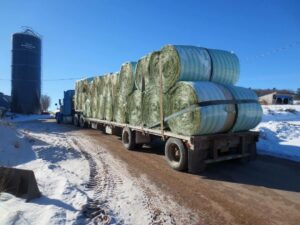
This is a load of very high quality hay the author purchased one winter that cost $50 per bale, plus delivery. It was still much cheaper than buying small square bales!
A core concept of feeding livestock is that we need to provide 2.5 pounds of forage dry matter for every hundred pounds of live animal. For instance, a 1,000-pound animal would require 25 pounds of dry hay, or its equivalent in higher moisture forages such as baleage, haylage, or corn silage. Cattle waste a certain amount of hay, so let’s say we need 3.0 pounds of dry matter for every hundred pounds of body weight. This then would require 30 pounds of hay per day per animal. Now let’s figure how much we need for the entire winter. We are going to choose a feeding period of 180 days, with a few extra days thrown in for insurance, and do calculations for at least a 200-day period. So, 30 pounds times 200 equals 6,000 pounds total for the season, per cow. That’s three tons per cow!
Before we go much further, I would like to point out some huge price differences in different forms of hay, which is most relevant if you are buying hay in. Typically, small square bales of hay cost $4-6 each, resulting in a cost per ton of $180-265 per ton. In contrast, you can purchase 4×4 dry round bales for $40-50 each, with a per ton cost of $120-150. That’s a huge price difference to pay! And small square bales take a lot more labor to handle! The moral of this story is that you must shop around and figure out what your per ton cost of hay will be. I always tell clients that if you’re selling hay, small squares is the way to go but if you’re buying hay then large round or large square bales is the way to go.
Moving further along, let’s say we have a herd of 20 beef cows. Okay, 20 beef cows, times 200 days, times 30 pounds per day, pencils out to about 120,000 pounds of hay, or 60 tons. If you can get the hay for $40 a round bale, or roughly three round bales per ton, the winter’s hay will cost you $120 per ton times 60 tons pencils out to $7,200. It’s also good to throw in a few extra bales for insurance for catastrophic weather conditions during the grazing months, so figure on buying in about $8,000 worth of hay to get through the winter and some “insurance” hay. You might cringe at that price tag, but you can easily spend much more than that on the costs of growing hay and maintaining haying machinery.

You must store dry hay under cover from the elements
Another typical example that we can rely on is that a 20-cow beef herd can easily eat 8 to 10 round bales of hay or baleage per week, and you can figure your costs out that way.
One thing to keep in mind is that all hay is not created equal. You can peruse the ads in social media marketplaces and see all kinds of hay available, and for all kinds of prices. Sometimes its better to find a good vendor who does a conscientious job in making his or her hay and who might charge a little more rather than someone who “takes” the hay year after year without any fertility inputs such as manure, lime, and fertilizer. Granted, beef cattle do not need dairy quality hay, buy they do need decent quality hay.
I might mention that the steps that you follow with all of these hay feeding calculations are just as applicable to any other class of livestock, such as dry dairy cattle, dairy heifers, sheep, goats, and horses. If a calculator can’t be your best friend, it can at least be an extremely useful tool! It’s all in the numbers!