
Under the Covers: Nursing Clovers to Maturity
Clovers can be wonderful cover crops, growing more than 100 lbs of nitrogen/acre and improving soil tilth with their large root systems, but they get off to a slow, weak start after seeding. Jerry and Val Carocci, who run Church Street Produce in Burdett, have dealt with this problem by using nurse crops for their clover.
Aptly named, nurse crops provide shelter for baby legumes during their puny stage, when their big bad world is full of heat, drought, and weeds. As part of the Cover Crop project, funded by Cornell Cooperative Extension and the NY Farm Viability Institute in 2007-2008, the Caroccis have tried two different clover/nurse crop systems, both with success.
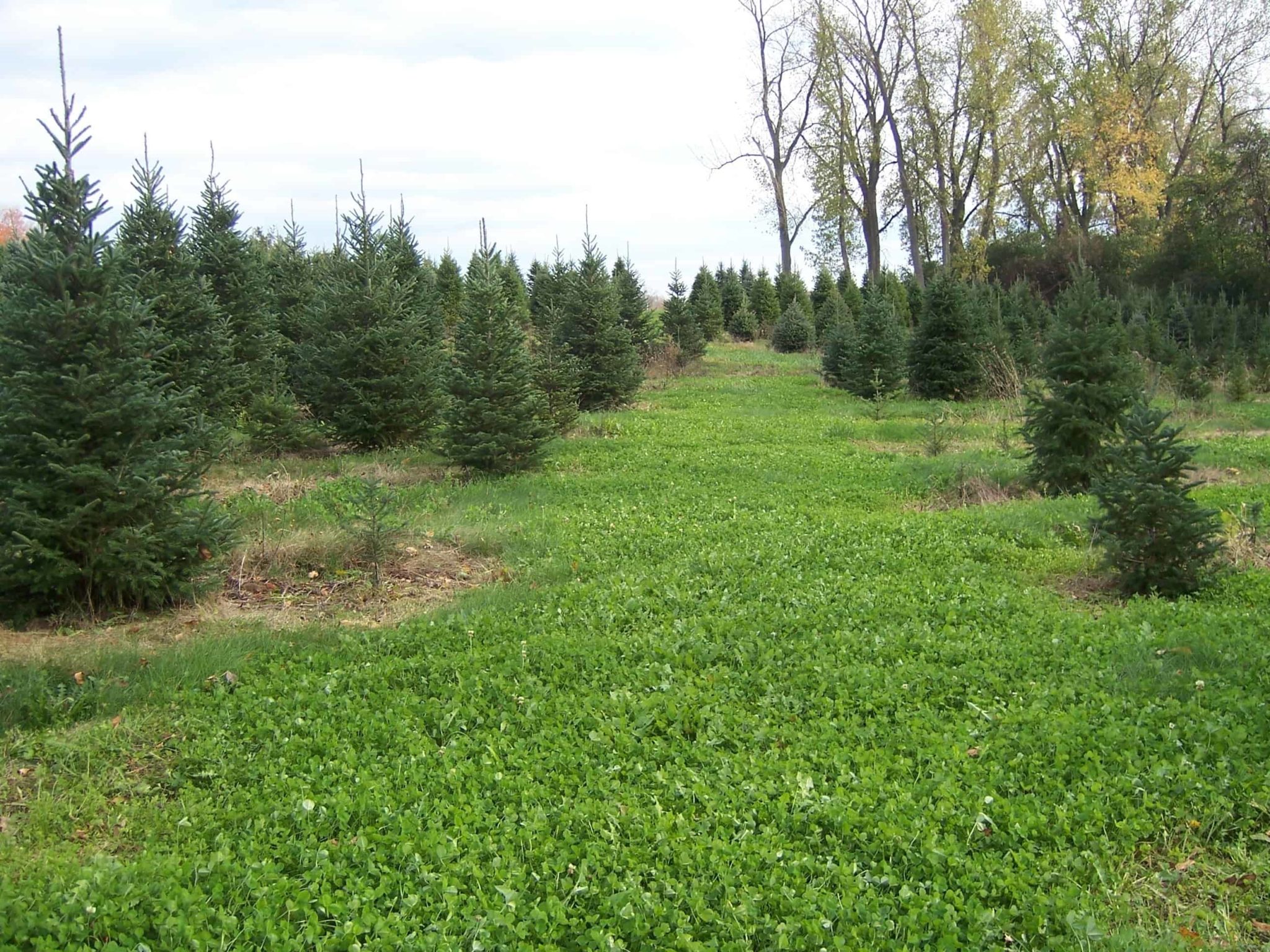
Nurse crops such as oats and buckwheat can help white clover develop into a lush cover.
Clovers seeded by themselves (without herbicides) are quickly swamped by fast-growing annual weeds, particularly when planted in August. The weed cover doesn’t seem to harm the clovers, which tolerate shade well and actually appreciate the cooler, moister environment down under the weeds, but annual weeds make tens of thousands of seeds before they’re killed by the frost, banking problems for years to come. Also, if perennial weeds are present (like yellow rocket, quackgrass, etc), they won’t be controlled by mowing and will be a much bigger problem than annual weeds like lambsquarter and pigweed.
The first nurse crop combination the Caroccis used was the classic oats and white clover, planted in late summer 2007. Using 1-2 bushels (35-70 lb)/A oats in combination with 4-6 lb/A white clover is about right—each species pure seeding rate is decreased some to allow the other some space. Oats have the added benefit of being cheap ($0.11/lb) so the combination cost about $25/A. The oats grew and provided shelter into late fall, died over winter, and the next spring the field was swamped by a lush stand of white clover.
In 2008, the Caroccis tried a new twist on the old nurse crop concept. They seeded 50 lb buckwheat and 10 lb medium red clover together in August. Buckwheat was $0.56/lb, and the clover cost $2.50/lb, so the combination cost $52/A. One advantage to using buckwheat is that it gives more thorough weed control in warm summer growing conditions than oats.
The soil was warm and the buckwheat took off. You had to look very closely to find the red clover hanging out in the shade. Then fall hit, the buckwheat was mowed, and the clover took over. When the growing season starts, the clover should grow really fast—it’ll be at its peak nitrogen content just before flowering, in early June. If it’s mowed at that stage it should die, but if it’s mowed earlier it will not have “finished,” and it will persist.
The biggest challenge the Caroccis have had is with their cover crop seeding equipment. They don’t have a tractor-mounted seed spreader, so they use what Val terms her “Johnny AppleSeeder,” a hand-held spin seeder. She’s had a hard time getting the seeding rate even throughout the field using that seeder. Also, they don’t have good tools to help incorporate the seed, and they’ve found their Perfecta field cultivator to be a little too coarse of an instrument in many cases.
Sometimes sowing two different seeds at the same time can be tricky because they might have different ideal rather than to fluff it seeding depths, but in the case of buckwheat and red clover, they’ll both be ok at ½ inch deep. One can broadcast the clover, then drill the buckwheat with a grain drill. If broadcasting both seeds, they should be spread in different passes, then pressed lightly into the soil. A cultipacker is great, but if you don’t have one, a drag works better than a disk. It doesn’t have to be fancy, an old set of bedsprings dragged behind the tractor even works. The key to a nice even stand is to firm the soil rather than to fluff it for better seed-to-soil-contact.
We can all use a helping hand, so try nurse crops to get your clover cover crops started.


Thanks for this article. I was attracted to it because the photo included shows a cover crop (clover?) being grown in a Christmas Tree field. But the article is about use of cover crops on what sounds like a produce /fresh vegetable operation.
Do you have any research on establishment of cover crops in Christmas tree fields; and specifically use of legumes for nitrogen fixation and weed suppressant? I’m a Christmas Tree farmer. Many thanks.
Hi Peter, thanks for reaching out! We have an article on our website by Elizabeth Lamb that covers weeds in Christmas tree plantings. Elizabeth briefly discusses ground cover as a weed management tool. Read the article here (https://cornell-small-farms-program.mystagingwebsite.com/tag/cover-crops/) or feel free to contact Elizabeth Lamb, a Senior Extension Associate with the Ornamentals Program of NYS Integrated Pest Management, at eml38@cornell.edu or 607 254-8800.
For those working in the nursing field, researching topics such as “sustainable healthcare practices” or “the role of nursing in public health initiatives” can be a great research paper. For help with your research, I recommend checking out topics for nursing research paper from nursingpaper service , who provide expert nursing paper writing help!
Quick Draw is not only a competitive game but also an opportunity to improve your drawing skills. Under time pressure, you will learn how to create simple but highly expressive images.
This article offers a clear, practical look at how nurse crops can give clovers the early protection they need to become strong, productive cover crops. It’s especially interesting to see how farmers adapt tools and techniques sometimes creatively to make these systems work in real-world conditions.
Zolpa store
Using nurse crops seems like a smart solution for overcoming the slow start that clover often faces. It’s great to see practical strategies, like combining oats or buckwheat with clover, to boost early growth and weed control. While the equipment challenges are a real issue, the Caroccis’ hands-on approach, using simple tools like a drag instead of fancy machinery, shows how resourceful farmers can be. Their experiences highlight the importance of experimenting with different combinations and methods to find the most effective solutions.
Outsourcing company in Nepal
As someone who’s been using the iPhone 17 Pro Max, I can confidently say that it’s a device that already delivers everything I need and more. Sure, the next-gen iPhones like the iPhone 18 Pro Max are bound to have impressive features, but for me, the iPhone 17 Pro Max feels like a perfect balance between performance, design, and value. With its top-tier A17 Pro chip, amazing camera system, and stunning display, the 17 Pro Max still feels cutting-edge and doesn’t fall short in any area, whether it’s gaming, productivity, or photography. See my detailed article on why I’m going to stick with ,a href=”https://medium.com/@harrismorrey/why-im-going-to-stick-with-iphone-17-pro-max-rather-than-chasing-higher-models-for-a-few-years-a256e307c2ec>iPhone 17 Pro Max rather than fall for iPhone 18 in 2026>
One of the biggest reasons I’m sticking with my iPhone 17 Pro Max is its longevity. Apple’s phones are known for their long-term software support, and I feel confident that this device will continue to receive iOS updates for many more years, keeping it relevant and functional. I don’t need to chase every new feature or hardware upgrade when what I already have offers a smooth, reliable experience.
Additionally, the incremental upgrades that each new iPhone model brings—while great for those who always want the latest—don’t always feel like game-changers to me. A slightly better camera, marginally improved battery life, or a faster processor doesn’t seem worth the high cost of upgrading when my current device still performs flawlessly. There’s also something to be said for avoiding the rush of having to keep up with every new release just for the sake of having the “newest” model.
So, for the next few years, I’ll be content with my iPhone 17 Pro Max. It’s a solid, powerful device that will continue to meet all my needs without the need for frequent upgrades.