Small Farms Program Hosts Agroforestry Summit to “See the Farm for the Trees”
On a wintry January day, while the trees and landscape lay dormant, one meeting space on Cornell University’s campus in Ithaca, NY, was alive with vibrant activity. More than 100 committed and passionate advocates for “trees on farms on purpose” gathered on campus for a first of its kind agroforestry summit. The Cornell Small Farms Program hosted “Beyond the Forest: Seeing the Farm for the Trees” to strengthen connections among the producers, service providers, researchers, and educators engaged in agroforestry in the Northeastern US.
The purpose of the day was not only to bring people together, but also to identify the highest priority actions to grow implementation of agroforestry practices. Cornell faculty and staff, faculty from UNH, UVM, and SUNY ESF, state and federal agency technical service providers, non-profit leaders, county and regional Cornell Cooperative Extension and Harvest NY staff, and dozens of producers attended this gathering to learn and engage in passionate conversation about strategies for advancing this movement.
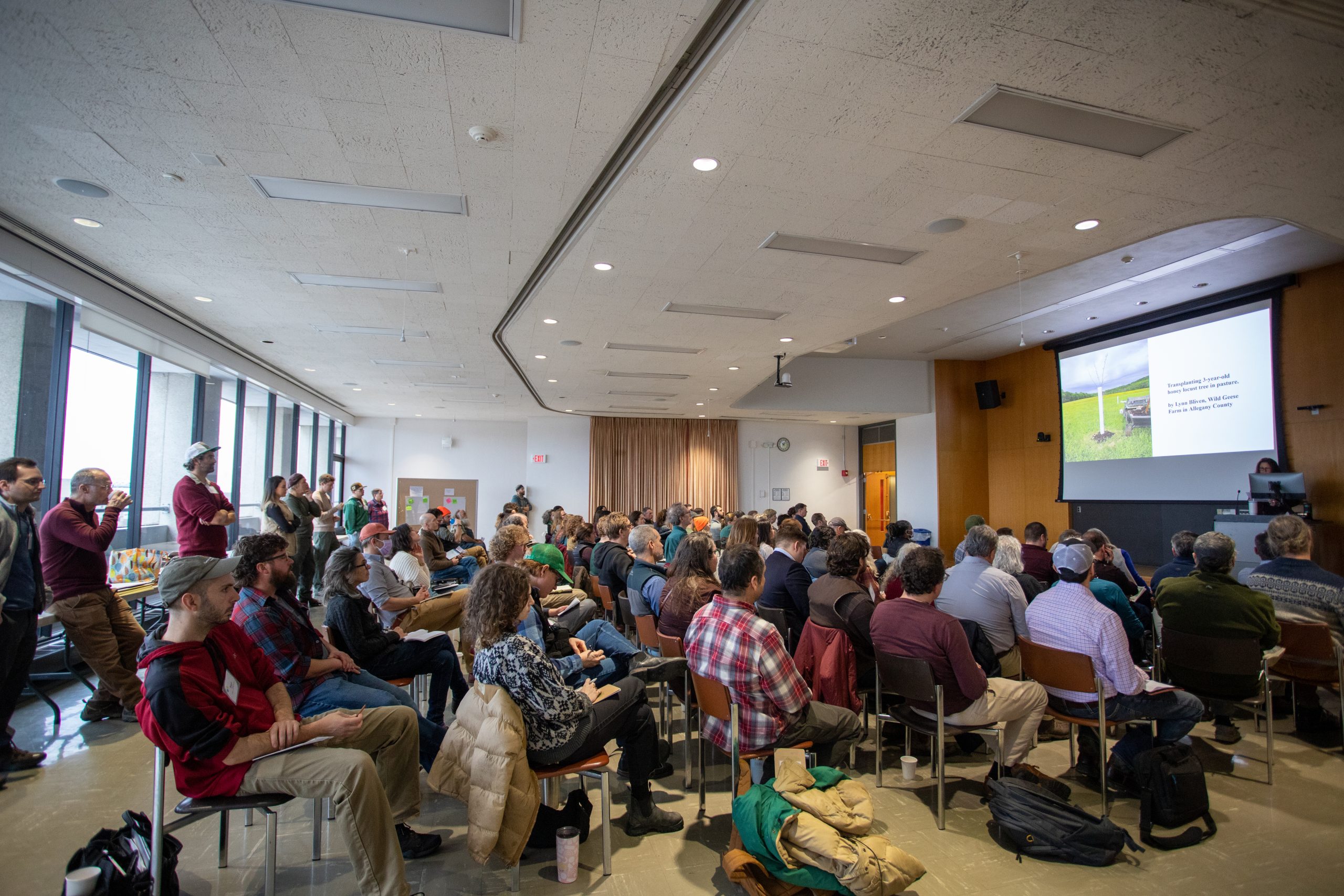
More than 100 committed and passionate advocates for “trees on farms on purpose” gathered for a first of its kind agroforestry summit, hosted by the Cornell Small Farms Program in January 2026.
Kacey Deamer / Cornell Small Farms Program
Agroforestry can look like many different things: thinning forests to graze cattle in dappled shade, planting rows of annual crops between rows of woody perennials, cultivating mushrooms on logs in the woods, and planting multi-storied food forests in urban areas are just a few examples of agroforestry in practice. At the summit participants heard inspiration from three producers describing how they integrate working trees on their farms. Kathie Arnold of Twin Oaks Dairy shared how she is adding trees to pastures to offer shade to her cows during the summer. Garrett Miller of Finger Lakes Cider House discussed planting thousands of black locust trees for shade for a large herd of beef cattle, but also for future timber harvest. And Sara Tyler of Black Squirrel Farms shared how she’s helping landowners find value in mature black walnut trees by building a collection network, a processing facility, and value chains as outlets for nuts and oil.
All three expressed the challenges they encountered in growing their businesses, including a lack of trained technical service providers, a lack of temperate research data to guide decisions and a lack of “perfect fit” with existing economic development and grant programs that make it challenging to take risks and move forward with growing these agroforestry practices.
Participants also heard about Cornell’s 100 years of engagement with agroforestry, which began with Professor MacDaniels’ planting of grafted nut trees in what is now known as MacDaniels’ Nut Grove near Dilmun Hill Student Farm, and continued with the establishment of the Arnot Teaching and Research Forest and Cornell’s Maple Program. Over the decades, agroforestry activity has waxed and waned, and in the last few years there has been a resurgence of interest from farmers driving new projects and research. Check out the Cornell Agroforestry Timeline at cornellagroforestry.org for a more detailed look at the history.
Mike Gold, faculty from University of Missouri, gave the keynote speech. Mike has been involved since the early years of Mizzou’s Center for Agroforestry, and he shared the diverse collaborations the Center has built and the wide-ranging impacts its work has had on the producers and the landscape of Missouri. He offered a very optimistic long-range assessment for the growth of agroforestry in the US as well as some strategic recommendations to build markets, spur peer-to-peer learning, and make research breakthroughs to catalyze growth in the industry.

The Cornell Small Farms Program will be synthesizing all of the notes from the Summit discussions into a report.
Kacey Deamer / Cornell Small Farms Program
During the afternoon portion of the Summit, participants divided into groups of 8-10 to examine a list of known gaps and debate the most important steps to take in the next five years to reduce these gaps. It has taken a century of inspiration, hard work and leadership from Cornell extension and researchers for this summit to happen and be meaningful. The human connections that were forged and the priorities that were debated will have a meaningful impact on how agroforestry dovetails with Cornell’s initiatives in the next 100 years. The participants created a consensus path forward, and it is now up to the Cornell community to navigate us there.
We have launched a new agroforestry-focused quarterly newsletter called Give Trees a Chance, where we will keep subscribers updated on events, funding opportunities, new research, and other relevant announcements for fans of working trees on farms. The Cornell Small Farms Program is building out new agroforestry resources on our website, and we co-lead two working groups on campus that meet regularly to learn together and strategize: the Agroforestry Program Work Team (PWT) and the Silvopasture Program Work Team. If you’d like to join either, please reach out to Connor Youngerman (Agroforestry), czy2@cornell.edu, or Erica Frenay (Silvopasture), ejf5@cornell.edu.