
Reclaiming and Establishing Pastures and Hayfields
In part five of our series, Where’s the Grass?, we share there are many ways to establish and improve grazing lands and hayfields.
People often ask me how they should go about improving their pasturelands and hayfields. The devil, as they say, is in the details. This all depends on what class of livestock you are feeding, what is the condition of the existing grazing lands, how much equipment you have, and how much you can afford to do.
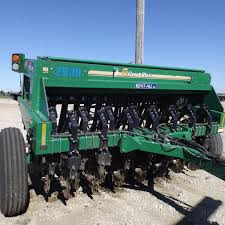
No till seeders are heavy and expensive, but excellent for establishing new seedings, elimination soil erosion, and all of the labor involved with conventional tillage.
Rich Taber / CCE Chenango
One of the beauties of pasturelands is that for much of the time they don’t need extensive work done to them except for normal maintenance activities. Taking soil tests, adding lime if needed, and adding manure or fertilizer for needed nutrients, and correct grazing management may be all the pastures need. A brush hog can be utilized to mow pasture paddocks once a year, maybe. One can go for years and years with doing little other than the above listed activities. But there may come a day that you would like to introduce some better and higher quality species of grasses and legumes into the stand. Also, some fields and pastures can be degraded by ruts, enormous woodchuck colonies, and operating equipment on the land when it’s too wet. Operating equipment on rough land is hard on both the equipment and the operator. Well then, how can we go about establishing a new pasture? I have written several times before about using the existing native seedbank that is in the soil. Add soil and nutrients, do some brush hogging, any you may end up having a really nice pasture. However, we may decide that we want something better than this, especially if we are trying to graze animals that need a higher plane of nutrition. Dairy cows and animals that are being finished for meat need very high-quality nutrients that may only be provided by having top notch grasses and legumes.

Moldboard plows are used for full, conventional tillage, along with disking, rock picking, and smoothing.
Rich Taber / CCE Chenango
We may have to use some form of tillage to establish a new seeding. This may involve plowing, disking, using spring tooth harrows, (dragging), picking rocks, rolling and smoothing, and then seeding with a grain drill that has a grass seeder, or a Brillion type seeder. This is full tillage, and the type that might be seen more often when establishing a new hayfield but certainly can be used for pasture seedings as well. Many small farmers may not have all of the equipment to do all of these activities, and you may need to hire someone to do this for you. Again, the beauty of a pasture seeding is that it only needs to be done rarely and sometimes never if you have everything is place. Compare this to row crops such as corn and soybeans where you have to do all kinds of tillage every year with the concomitant fuel, labor, seed, and machinery costs.
There certainly are other less expensive but somewhat less effective ways to improve and establish pastures. You can try frost seeding, where seeds are broadcast in the early springtime during maple syrup weather, in other words cold nights followed by warm days. The freezing and thawing allow the seeds to work their way down into the soil, much as nature allows seeds to get established in the wild. Frost seeding can be used to improve smaller sections of a field that need improving, rather than expending time and resources over the whole field that may not need it. Broadcast seeders can be mounted onto the three-point hitch of a tractor or even an ATV. The disadvantage of frost and broadcast seeding is that it is relatively inaccurate, and it is very hard to get good, even patterns of seed distribution over the field.

A roller crimper is a very useful tool for killing existing sod in a no till seeding.
Rich Taber / CCE Chenango
Finally, we can discuss no-till seedings. No till seeders are bigger, heavier built, and much more expensive than a regular type of seeder or grain drill. The beauty of a no till seeder is that it eliminates all the tillage, uses much less fuel, and allows seeds to be drilled into an existing sod, drastically reducing soil erosion. However, the existing sod must first be killed with either an herbicide, or with an organic roller-crimper. In this article I will not get into all of the pros and cons of using an herbicide to kill the sod, which usually entails the use of a glyphosate containing compound. I suspect that many of the Small Farm Quarterly readers would lean more to organic methods, and this is where using a roller crimper comes in handy. A roller crimper is a large, cylindrical shaped roll with horizontal knife blades attached to it that roll, crush and kill the grass, typically cutting the existing plants in eight locations. Then you can follow this activity with the no till planter. One disadvantage of a not till seeder is that they are extremely expensive, and a small-scale farmer will not likely own one. Again, hiring this done by a farmer who does have one can be a win-win situation. Some Soil and Water Conservation Districts own no till seeders, which can be rented.
In conclusion, there are many varied ways of improving and establishing new pastures and hayfields. It reminds me of the old saying “It takes a whole village to raise a child”. Well, it can take a whole village, metaphorically speaking, to put together a new pasture or hayfield. Many small farmers cannot afford all of the equipment and skill sets needed to do this task, and you will need to rely on friends, neighbors, and vendors. It may cost a good bit of money, but it can be money well spent.
This article is one of an ongoing series on pasture maintenance and utilization. Previous versions can be accessed in the archives of the Small Farms Quarterly at www.smallfarms.cornell.edu.