

Regardless of the location, species, and method, there are seven main steps to the process of growing mushrooms. Keep in mind that while the steps below are generally true for all methods and species, there is quite a bit of detail depending on the species of mushrooms and growing medium you choose. Here we overview the key points to each step in the process. From this, you can see which strategies emerge for your enterprise that align with your mission and goals.
- Strain selection
- Substrate preparation
- Inoculation
- Incubation
- Initiation
- Fruiting
- Harvest
Incubation (Spawn Run)
After inoculation, the spawn needs time to grow through the substrate. This process is called incubation. Incubation starts with leap off, which is the moment when the mycelium initially leaps off the spawn onto the new substrate. This typically occurs around four days after inoculation. The mycelium expands through the substrate in a three dimensional sphere. When the mycelium runs into another leap-off point, the mycelium fuse together until the entire substrate becomes one mycelial organism. When the mycelium has grown throughout all of the available food, full colonization has been achieved and they can now be initiated into fruiting.
The rate at which spawn run happens will vary given the density of the substrate and species of mushroom. Oyster, for instance, is faster growing than shiitake. A sawdust-based substrate is much faster than logs. In general incubation time is as follows:
Shiitake logs: 6-18 monthsOyster logs: 4-12 months
Stumps: 24-36 months
Woodchips: 2-12 months (limit incubation time by flipping active bed into new chips)
Oyster on straw: 14-28 days
Oyster on sawdust: 10-20 days
Shiitake on sawdust: 42-84 days
Most specialties on sawdust: 21 days
During incubation, temperature and humidity control are the two primary factors to maintain. CO2 and lighting are not important during this phase. They can be adjusted for the comfort and utility of the humans that work in incubation.
Incubation for Outdoor Cultivation
The most important factor during incubation is to ensure the mycelium doesn’t dry out. When growing on logs, if the ends begin to show cracking which is big enough to fit a dime into, it is time to soak. Soak the logs for 6-8 hours to get water deep into the log, this should not need to happen more than once per month during the summer months. For wood chip beds, watering right at inoculation and once a week for a month after should be adequate. As long as the bed is located in the shade and chips are 4 inches or deeper, they will maintain high moisture content.
Incubation for Indoor Cultivation
During indoor cultivation, incubation can be an important factor in space utilization. By decreasing the amount of time spent in incubation, more bags can be produced in the same amount of space. Playing with variables like temperature, inoculation rate, strain, and substrate can have big impacts on incubation time, allowing more mushrooms to be produced in the same amount of space. Compared to outdoor incubation, water content is not so much an issue as temperature. Since the substrate is contained in a plastic bag or something similar, water does not readily escape. During substrate preparation, the substrate should have received all the necessary water for spawn run. Temperature during incubation should not exceed 80 degrees F and is ideally around 70 degrees F. When using 5- or 10-pound bags of supplemented sawdust, the internal temperature of the bag can be 10-15 degrees F warmer than the outside. If the exterior temperatures are 80 degrees F, the internal core could be 95 degrees F, which is getting warm enough for the mycelium to cook itself and introduce contamination. Exterior temperatures can drop as far down as 50 degrees F, but incubation will take longer. Generally, in a well insulated room, cooling is more important than heating as the mycelium generates heat as it grows.
To ensure the bags do not overheat during incubation it is important to give them space on the shelving. A good general rule is to have a hand’s width of spacing between each bag. This allows adequate airflow to pass between each bag. If the bags are touching those spots can easily overheat from the heat generated by the mycelial growth. This causes mycelial dieback and can introduce contaminants.
Shiitake Incubation
Shiitake on sawdust blocks are particularly finicky during incubation. They have two extra parts to colonization that most species do not. When full colonization is reached, shiitakes have another 4-5 weeks of incubation. After full colonization, popcorning begins, the block becomes textured and bumpy, and finally around week 5 the block starts to turn brown. Shiitakes should not be moved out of incubation until 75% of the block has turned brown and popcorned. If shiitake blocks are touching each other they will not popcorn and will not produce mushrooms in that spot. It is critical to give shiitake blocks a palm’s distance between each bag during incubation.
Shiitakes are much more sensitive to being induced into fruiting by physical shock or temperature swings. If incubating shiitakes, try to minimize temperature swings. If temperatures drop below 55 degrees F after week 4 or 5, the blocks tend to fruit instead of completing popcorning and browning, greatly reducing yields. Physical shock by moving the blocks or rearranging them will also induce early fruiting. Once shiitake are on the shelf, leave them alone for 6-7 weeks until most of the blocks have fully popcorned and turned brown, then move on to fruiting.
Initiation
Initiation is the link between mycelial growth and mushroom formation. This is the time when the substrate is fully colonized and maybe even showing signs of pinning. To initiate fruiting, lowering temperatures and increasing oxygen levels generally encourages mushroom formation. Initiation can be in the form of cold shocking, water shocking or introducing more oxygen by cutting a hole in the bag.
Shocking: Shiitake mushrooms respond very well to shocking. These methods of shocking are not typically used with any other species of mushroom. In log production, this is done by soaking the logs for 24 hours, inundating them with water as if in a strong rainstorm. When using blocks, they typically only need to be soaked for 5-12 hours. Another method of shocking is cold shocking. Refrigerating shiitake blocks for 12-24 hours induces a strong pinset to form. Shiitake blocks are placed in a walk-in cooler for 12 hours and then the plastic bags are stripped off to initiate fruiting.
Cutting: With many other species like lions mane, chestnut, oyster, and king oyster the plastic bags are cut, exposing small areas to the oxygen rich environment, to encourage fruiting. Since the mycelium is all one organism, the energy is sent to the places where fruiting can optimally occur. When cutting the bags, it is good to have the plastic covering the substrate to maintain a high humidity. Different species are cut in different ways.
Oyster, chestnut, pioppino mushrooms: For initiation of these mushrooms, bags can be cut corner to corner on the broadside of the bag. Bags can then be laid down so the fruiting is on top or the fruiting can happen on the side. Second flushes will happen from the same cut. Be sure when harvesting to remove all mushroom material.
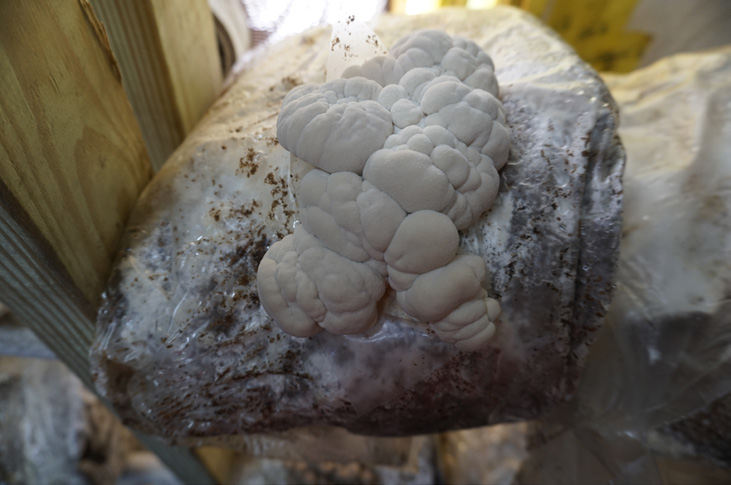 Lion’s mane: For initiation of lion’s mane, small v’s or x’s are cut into the bag. Typically two can be cut on the broad side and one on the compact side of the bag. Mushrooms can form to fistsize from these small holes so be sure to give adequate spacing between cuts. Lion’s mane should be side-fruited, as top fruiting can gather water and encourage disease.
King oyster: King oyster requires higher humidity and sometimes scratching or casing for initiation. King bags are usually top fruited. The bags should be cut open at the top, leaving 3-inches of plastic above the substrate. This greatly increases humidity and allows mushroom to develop a long stem as desired.
Fruiting
The fruiting process is as much an art as it is a science. Direct observation of the mushrooms and substrate is needed throughout the fruiting process and for each crop. The mushrooms, in their morphology, color, texture, and abundance communicate what it is they need during the fruiting process. Just as there are many processes to grow mushrooms, there are countless ways to fruit mushrooms. Mushrooms can be fruited in a huge range of environments; from simple outdoor fruiting to indoor, highly controlled environments. Indoor fruiting rooms can range from a single shelf all the way up to a tractor trailer. Regardless of how one chooses to fruit mushrooms, there are four primary perimeters to consider:
- Temperature
- Humidity
- Lighting
- Oxygen
Temperature
For most species, temperatures in the 60’s F are ideal. The highest quality mushrooms with good fruiting speed develop at temperatures in the low 60’s F. If a fruiting room was designed perfectly, keeping it around 62-65 degrees F would be ideal. This is a big part of the appeal to fruiting mushrooms in basements and other in-ground areas. By fruiting in a basement, temperatures can be kept in the range of 50-65 F with little to no supplemental heating/cooling. As temperatures decrease, mushrooms tend to fruit slower but have a meatier texture. Once temperatures drop below 50-55 F many species greatly decrease their productivity. As temperatures increase, mushrooms become thinner and go past maturity quickly. As temperatures rise above 75 F, many species reduce their productivity and become a low quality mushroom. Some growers shift the species being grown based on seasonal temperatures. For example, if growing oyster, shifting from Pleurotus ostreatus (blue or pearl oyster used in fall, winter, and spring) to Pleurotus pulmonarius (phoenix oyster used in summer) can help the business adapt to increasing temperatures in the grow room.
Humidity
Humidity is most critical during the first 4 days after initiation. During these tender days, baby mushroom pins are beginning to fruit. Humidity should be kept above 85%. As time goes on, the mushrooms become more resilient, and are able to withstand lower humidity levels. After about 3 days of pinning it is okay for humidity levels to drop as low as 60%, but ideal conditions mean keeping humidity in the 80% range. Humidity is usually maintained with some sort of commercial humidifier and a humidistat or timer that shuts the equipment on and off.
Lighting
Lighting is the simplest part of creating environmental parameters for healthy mushroom fruiting. If a book can be read comfortably in the fruiting room space, your lighting should be sufficient. The old adage of “keep mushrooms in the dark and feed them shit” doesn’t apply with specialty mushrooms. Specialty mushrooms, unlike psilocybe and agaricus (button) need light for proper morphology. There isn’t a particular light spectrum that is needed as the mushrooms are not converting light into energy. It seems the mushrooms use light as a measurement of how far to extend their stems. Low-light environments create skinny mushrooms with long stems, similar to plants that are grown in low-light environments. Regular shop lights in the room will work just fine, and LED strip lighting can be used for its energy efficiency.
Oxygen
Keeping the room fresh with oxygen is really what makes the whole art of fruiting mushrooms a dance. Mushrooms, like humans, breathe in oxygen and exhale CO2. When a room is filled with mushrooms and mycelium and sealed up, oxygen starts to run out. Fresh air needs to be brought in to keep CO2 levels below 1000 PPM for most species. Oysters are a little more picky and should be kept below 800 PPM. A general rule is to exchange all the air in the room every five-ten minutes. It is better to blast new air in, exchanging all the air in a minute or two, than have a low level fan on constantly. For example, if a grow room is 10x10x7 that is 700 cubic feet. A fan that is rated at 720 CFM (cubic feet per minute) will bring all new air into the room in one minute. This fan could be hooked to a timer and run for 60 seconds every 7 minutes or so for sufficient air exchange. Most growers install both an intake and exhaust fan and time them to run together. As you bring in fresh air, take consideration for its effect on the humidity and temperature level. For example, bringing in 100 F air into a chamber you want to keep at 65 – 70 F means your cooling system will have to work harder. When CO2 is high, oyster and other mushrooms will form with long stems and little caps.
Harvest
The bounty of all this work! Time to harvest. It is critical to harvest at the right time. With most cap and stem mushrooms, this is as the gills are exposed but the cap margin is still curled under. This is optimal for quality and long term storage of the mushroom. The harvest window can be relatively short, especially in the summer or when temperatures rise above 75 degrees. Mushrooms need to be harvested every day to ensure the highest quality unless fruiting temperatures are below 60 degrees. If this is the case, harvesting some slightly premature mushrooms can allow one day to be skipped before needing to pick again. Mushrooms should be harvested into a container which allows breathing. Plastic with holes in it or cardboard boxes work great. It is very helpful if the containers are rigid to protect the fragile mushrooms inside.
Used bulb crates are a great option for harvesting mushrooms into. If possible, harvesting into the final packaging is a great way to save time and minimize handling of the mushrooms. Mushrooms can be very fragile post harvest, especially oysters. By minimizing handling, these mushrooms can look way better than any grocery store mushroom. The broken margins on oysters in grocery stores are from excessive handling between the harvester and the consumer. If selling 5 lb cases to restaurants, harvest directly into the cases to sell the highest quality mushrooms. Once the mushrooms are harvested, cool them immediately. Harvested mushrooms should be stored at 34-37 degrees F and will last for about 7 days (if harvested at the right time) before needing to be sold. Shiitake tend to have a better shelf life than oyster or lions mane.

