
Improvising, Adapting, and Overcoming on the Farm: Adaptive Equipment Empowers Veteran Farmers
Physically disabled veterans are making significant strides in agriculture by utilizing innovative, adaptive equipment tailored to their unique needs.
Farming traditionally demands physical strength, agility, and balance, posing substantial challenges for veterans with physical disabilities. The limited availability of tools designed to address these challenges means many veterans must either engineer custom solutions themselves or collaborate with others to develop adaptive equipment. By creating and utilizing these specialized tools, these veterans are not only overcoming physical limitations but also achieving remarkable success in their agricultural endeavors, inspiring broader advancements in farming technology.
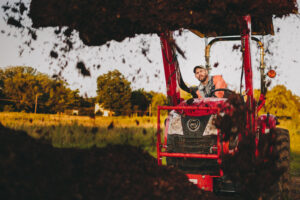
Thomas Martineau, Air Force veteran and co-owner of Elle Pea Acres in Lansing, NY, turns a compost windrow with his tractor’s bucket attachment. Martineau, who became a paraplegic while in the Air Force, has adapted several pieces of farm equipment to allow him to work effectively.
Thomas Martineau, a 39-year-old Air Force veteran and paraplegic, has successfully adapted to life and work on his 40-acre farm in the Finger Lakes region of New York. Despite the physical limitations of using a manual wheelchair, Thomas and his wife, Kiersten Downs, have embarked on a journey to create a sustainable flower farm. His story exemplifies the resilience and technical innovation that disabled veterans must use to make the farming visions reality.
Martineau explains, “After my accident, while I did rehab, the hospital had programming around how to garden post-injury and how to employ adaptive-use gardening tools. They opened the door to this wonderful world of farming for me.” This initial exposure to adaptive gardening set the stage for his future endeavors in sustainable agriculture, culminating in his recent graduation from UMass Amherst with a degree in Sustainable Food and Farming and the launch of his and Downs’ farming enterprise, Elle Pea Acres.

Kiersten Downs and Thomas Martineau, Air Force veterans and co-owners of Elle Pea Acres in Lansing, NY inspect flower heads for insect damage. They have made their growing beds accessible for Martineau’s wheelchair using large pieces of weed barrier fabric over impacted ground.
A crucial element of Martineau’s success has been his access to adaptive equipment, such as his modified tractor. “The tractor dealership had a fabricator who used to build race cars. He built a very sturdy handle for me to use to ‘dip up’ into the tractor and fabricated a hand control that attaches to one of the pedals,” Thomas shares. “I use the tractor to break ground for new growing plots. I can mow and brush hog the property. It has a bucket and forks, so I move hay bales with the forks, and I use the bucket a lot for manure management for the horses and donkeys. Since I do have limitations being in the wheelchair, being able to use the tractor is important for me in that it is one way I can contribute to the labor on the farm. My wife and I have been pretty active, and I have a huge community of disabled friends, contacts, therapists, and doctors who are up on what’s new. I’ve been witness to some really incredible advances in adaptive technology.”
Despite his successful use of adaptive tractor hand controls, Martineau emphasizes the scarcity and high cost of adaptive farming equipment. “The problem with most adaptive equipment is that it is way too expensive for most people to afford,” he notes. “I have a few ideas of how certain things could help me, but I would need to fabricate it all myself. Since there are not a lot of people like me doing what I’m doing, there is just not the economy of scale to develop anything. I’ve been in a wheelchair for 16 years, and in that time, I have learned you just have to ‘figure it out’ yourself most times.”
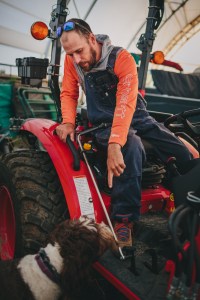
Thomas Martineau, Air Force veteran and co-owner of Elle Pea Acres in Lansing, NY, explains how his custom-fabricated hand controls for his tractor operate.
Dean Koyanagi, a Marine Corps veteran and tech-tinkering farmer, adds another perspective on the challenges faced by farmers employing adaptive farming technology. Koyanagi explains, “Fewer farmers [are living] in close proximity, that limits sharing resources and just basic helping each other with on-farm projects, also reduces the more spontaneous support between farmers for innovation and adoption of adaptive technologies.” He emphasizes that new farming techniques and equipment have a slow adoption process, noting that it often takes years for awareness of new innovations to become widespread.
Koyanagi participated in a prototyping accelerator program last year, which emphasized understanding the technology adoption curve. He learned that the price of adoption of new adaptive technology can be prohibitively high and often with unclear cost-benefit analysis for a farmer. He relates, “The expense to cultivate a crop with a piece of adaptive tech doesn’t usually translate to suddenly making that crop more profitable and that can make it hard to pitch tech to someone who might really benefit from it in other ways, like improved health.”
One resource farmers with physical disabilities can access when looking for new adaptive equipment and processes is the AgrAbility Toolbox Assistive Technology Database. Steve Swain, a member of the National AgrAbility team and member of the group who submits and reviews new products and systems for the Toolbox, explains the database, saying, “New products are brought to the group for review and approval before they are included in the database. These products can be submitted by the group or other AgrAbility staff members. It is then reviewed by our engineers before inclusion in the database.”
Koyanagi highlights the importance of collaboration in developing and refining adaptive equipment. He shares, “Working with other farmers has been invaluable. For instance, I collaborated with a neighboring farmer to develop a prone weeder which has significantly reduced my back pain while weeding. This collaboration not only improved my work but also inspired my neighbor to adopt similar practices.”
Joe Ricker, the Veteran Outreach Coordinator for the national AgrAbility program, also emphasizes the importance of sharing knowledge among farmers, saying, “I believe the way ahead is more collaboration. Veteran farmers speak the same language. There are some silos that can be broken down through evolving communication technology and talking with one another.”
Looking ahead, Martineau sees potential in the development of more accessible hand tools and technologies tailored to specific disabilities. He envisions a future where “a line of hand tools developed for gardeners with disabilities” could significantly ease the physical demands of farming for disabled individuals. Koyanagi echoes this sentiment, highlighting the need for open-source solutions and fabrication training to empower farmers to create their adaptive tools.
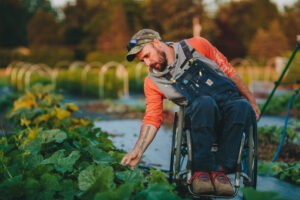
Thomas Martineau, Air Force veteran and co-owner of Elle Pea Acres in Lansing, NY inspect flower heads for insect damage. Thomas and his farming partner have made their growing beds accessible for Martineau’s wheelchair using large pieces of weed barrier fabric over impacted ground.
The stories of veterans like Thomas Martineau, along with the efforts of organizations serving veteran farmers such as AgrAbility, demonstrate the transformative power of adaptive equipment in empowering disabled veterans to pursue farming. While challenges remain, the dedication and ingenuity of these farmers lead the way for a more inclusive and supportive agricultural community that values the experience, resilience, and perseverance of disabled veterans.
For more information on adaptive farming tools and resources, visit the AgrAbility Toolbox.

