
Cucurbit Downy Mildew on Cucumber: New Strains, New Varieties
Cucurbit downy mildew (CDM) (Pseudoperonosporacubensis), is a serious disease of cucurbits worldwide that attacks all cultivated cucurbits. Symptoms progress from yellow, angular lesions on the upper leaf surfaces restricted by leaf veins to the production of gray sporangia that can be seen on the lower leaf surface. Lesions expand, become necrotic, and kill the leaves. The sporangia become airborne, land on other leaves and, with appropriate temperature and leaf wetness, will germinate to infect the plant. This rapid production of large numbers of sporangia makes P. cubensisa a particularly explosive pathogen. (more photographs of symptoms)
The identification of CDM is straightforward at the initial stages on cucumber plants where the jigsaw puzzle pattern on the upper side of leaves is quite unmistakable, but these early symptoms can be much less distinctive on melon and squash. With all the cucurbits, the appearance of spores directly below the yellow sectors is dependent on environmental conditions. The disease progresses rapidly and as quickly as within two weeks the leaves will be completely dead, brown and shriveled. Squash petioles survive noticeably longer than the leaves and remain green and erect, holding up the brown, shriveled leaves.
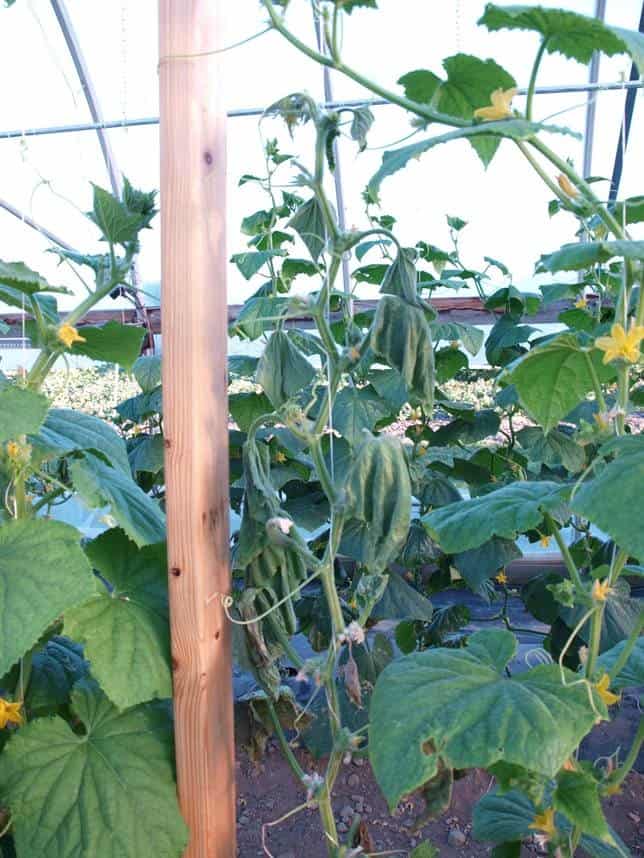
Symptoms of bacterial wilt on cucumber for comparison
In the US, CDM was the most serious pathogen of cucumber until the late 1940’s and 50’s, when resistant varieties were released. However, in 2004 and 2005, the pathogen re-emerged as a serious threat to cucurbit production in the US. The pathogen cannot live year round above 30 degrees latitude (southern Florida). Thus, each year the first crop in the US to be infected with cucurbit downy mildew is found in Florida sometime between mid-February and early April. The pathogen will then move north as additional cucurbit crops are planted. For many years, cucurbit downy mildew would not be seen in Upstate New York until very late in the season (late August or September). However starting in 2005, the pathogen has been found in cucumber fields in July. It is possible that winter greenhouse production of cucumbers is enabling P. cubensisto overwinter and infect field-grown plants earlier in the season.
Regardless of origin, new strains that overcome host plant resistance are now present in the US. Cucumbers are very vulnerable, and although early season production is often harvested before the pathogen arrives in our area, mid and late season harvests are tenuous. Melon harvests are largely influenced by a loss of fruit quality as the pathogen depletes the plants’ production of sugars for the developing fruit. Summer and winter quash are fortunately more resilient.
High tunnel production is a promising approach to controlling the CDM. High tunnels naturally maintain a drier atmosphere than open field production that limits leaf wetness thereby depriving the pathogen of the wet environment it needs to complete infection cycles. Other pathogens remain problematic or are amplified in a high tunnel environment. Powdery mildew does not require free moisture like CDM and is able to multiply readily in high tunnels. Bacterial wilt symptoms are often amplified in a high tunnel environment because the bacterial accumulation in the plant vasculature restricts transpiration.
CDM management in NY now requires a combination of new cultivars with resistance to the new strain, and precisely timed chemical controls. Growers can monitor the distribution and movement of the disease in the US online through the CDM ipmPIPE. This website helps growers know when to spray a cucurbit crop or make other decisions by being aware of when downy mildew has been observed in a neighboring county. For automatic updates, the CDM alert system allows growers to receive updates by e-mail or text messages when pathogen has been reported a selected distance from a chosen location. In 2012, the site received confirmed reports of CDM in Suffolk County on July 17th, Erie County July 25th, and Ontario and Seneca Counties on August 7th and 8th respectively.
The search for resistant cultivars had not been promising until recently. Studies on melon identified undomesticated sources of resistance decades ago but little work had been done to transfer this resistance into a modern commercial cultivar. A survey of squash done at Cornell in 2009 identified several sources of resistance. In the case of both melon and summer squash, Cornell is actively working on the development of new cultivars with this needed resistance. Cucumber has received more attention. Several studies from North Carolina have identified weak resistance in some cultivars. Studies at Cornell have identified partial resistance in a slicing cucumber that is commercially available, ‘Marketmore 97’. Two new cultivars from Seminis Seed Company, SV3462CS and SV4719CS, promise to have improved resistance and are available as treated seed.


We have had nothing but rain here in Southern Missouri for months- it is just now sunny with bits of rain not torrential downpours
My cucs have Leaf symptoms of cucurbit downy mildew on cucumber is copper fungicide enough to cure it or what do we do, our gardens are having enough trouble growing things due to the saturation, I had to start over “again”
thanks
Gwen,
I suggest reaching out to the author, Dr. Mazourek, for the answers to your questions. His email is included in the article. Also, check out http://nysipm.cornell.edu/organic_guide/cucurbit.pdf. This NYS IPM Publication has information on disease management for cucumbers.
Cucurbit downy mildew is a serious concern for growers, especially for cucumbers. This article provides excellent insight into the spread of the disease, its symptoms, and how to manage it effectively. It’s great to see progress being made in developing resistant cultivars and the availability of tools like the CDM alert system for monitoring. Using high tunnels also seems like a promising strategy to reduce leaf wetness and control the spread of the disease. Thanks for sharing these valuable insights to help protect crops!
Telegram provides an excellent platform for sharing real-time updates on plant diseases like Cucurbit Downy Mildew (CDM). This article highlights the urgency of addressing CDM’s rapid progression, emphasizing how early detection on cucumber leaves can make a significant difference in controlling its spread. Collaborative groups on Telegram could enable farmers and researchers to exchange observations and mitigation strategies quickly.
Telegram ability to host visual content could support educational initiatives about the symptoms of CDM on different cucurbits. This article’s description of the yellow, angular lesions and the importance of environmental conditions for spore production underscores the need for widespread awareness, which Telegram groups can foster effectively.
ağlık Tüyoları: Sağlıklı Yaşamın Adresi
Sagliktuyolari.com, sağlığınızı korumanız ve yaşam kalitenizi yükseltmeniz için ihtiyacınız olan tüm bilgileri sunuyor. Beslenmeden egzersize, hastalıklardan korunma yöntemlerinden doğal tedavi önerilerine kadar zengin içerikler sizi bekliyor. Sağlıklı bir hayata birlikte adım atın!
sağlıklı yaşam, sağlık bilgileri, beslenme önerileri, egzersiz rehberi, doğal tedavi
The author had a way with words that drew me in from the very first sentence, and I found myself eagerly reading on to soak up all the knowledge they were sharing. Their writing was clear, concise, and engaging, making it easy for me to digest the information they were presenting. Assignment writers in Sri Lanka.
The author did an excellent job of breaking down complex topics and presenting them in a way that was accessible to readers of all levels of expertise. Assignment writers in Sri Lanka would do a good job there. Not only was the blog post well-written, but it was also incredibly informative.
I learned so much from reading their post, and I came away with a deeper understanding of the subject matter they were discussing. assignment writers in Sri Lanka would do a good job there.
SSSTikTok ID lets you save TikTok videos without watermarks in HD. No registration needed – just paste the link and download in one click!
su arıtma cihazları ve filtreleri hakkında değerlendirmeler, karşılaştırmalar ve haberler sunan bir platform supuan.
Great, informative article! I especially appreciate the clear explanation of how new strains of cucurbit downy mildew challenge existing resistant varieties, and the practical tips on using high tunnels and monitoring systems. Thanks for sharing this — it’s really helpful for growers trying to stay ahead of the disease, see service!