
Making Money
It is important to have an understanding of the technical financial aspects of your business in order to assess practices, management strategies, and planning moving forward. This fact sheet breaks down the elements to be considered and discusses cash flow, net worth, and profit, as well as interest on equity, and the value of labor and management on your farm.
Setting Profit and Income Goals
Experienced farmers set profit goals at the beginning of each farming season. Just like production or marketing goals, profit goals allow you to easily measure business success and stability. Goals will vary from farm to farm depending on expenses, sales outlets, and many other factors (remember that profit equals income minus expenses). Profit might need to cover your time, loan principal payments, or the purchase of new supplies, equipment, or land. Regardless, farmers should set profit goals from the get go. Meeting this goal will be dependent on income and expenses of the following season.
Income goals are slightly different but just as important to have. Income is dependent on the amount of each product that is sold.
How Will You Know if Your Operation is Making Money?
Cash Flow, Net Worth and Profit: These are the three pillars that sustain a business, and all you need for a business to thrive long term.
Cash Flow
Cash Flow tracks the cash dollars into and out of the farm business. You should be able to balance all of the money that came in and went out:
Start-up money + Cash from operations + Borrowed money =
Cash paid on expenses + Debt payments + End of year money
In horticultural operations, cash flow expenses will be high in the spring as crops are planted and income will be high in the fall when crops are sold. Therefore, cash flow requires planning and savings to be sure income covers future costs. Cash flow records are a way to keep track of your money, ensure that you can cover monthly expenses, and are crucial to long term profitability.
Net Worth
Net Worth tracks your investments in the farm in the form of the Balance Sheet.
Net Worth = everything the business OWNS minus everything it OWES
Assets You Manage – What you Owe = Your Ownership
Assets – Liability = Equity
Some assets tend to go up in value over time such as land. This is called appreciation.
Some assets go down in value over time, such as equipment. This is called depreciation. Depreciation is a measure of the wear, tear, and obsolescence of an investment.
The primary function of net worth calculations is to measure the risk-bearing ability or financial solvency of your business or, in simple terms, how much you really own versus how much the bank owns.
Profitability
Profitability is measured with the Income Statement. It is the result of your operation’s work, decisions, and return on investment.
Value of Production – Cost of Production = Profit
Profitability is harder to track as it blends cash flow and investment decisions. It also makes adjustments for family withdrawals, “free or family” labor, and return on investment.
Some examples of Good Cash Flow, but Low Profitability:
- Living off of inventories or depreciation, and not reinvesting in the operation
- Outside income or off-farm jobs that help reduce need for family living withdrawals
- Borrowing money
- Not paying bills
Some examples of Bad Cash Flow, but Good Profitability:
- An expanding business with increasing assets, but few cash sales
- High withdrawals for family living, for example, college expenses
- Paying down debt rapidly
- Buying next year’s assets from this year’s cash (prepay for fertilizer, etc.)
- Increase in accounts receivable (amount of money you are owed for assets that were sold)
Accounting Methods
For your tax return you may want to use cash accounting, but for profitability you want to use accrual accounting. Accrual accounting looks at changes in inventory and price; changes in accounts payable and receivable, appreciation and depreciation, unpaid labor, opportunity costs to work elsewhere, interest on equity, and your labor and management inputs.
Interest on Equity
Bank lenders will not let you borrow money without interest but many will lend without interest. You should plan on paying yourself 3% of minimum return on equity invested in your farm.
- Can you borrow money without paying interest?
- Do you have an “opportunity” to put your money somewhere else?
- Do you want to earn interest/dividends on your money in the stock market?
- Shouldn’t you earn interest on the money invested in your farm?
- Plan to pay yourself 3% minimum on your equity invested in the farm!!
Value of Labor and Management
What is the value of your efforts on the farm?
- What is the “opportunity” for you to work elsewhere?
- A simple charge for your efforts will help you find a value to evaluate your business
- What could you earn if you worked elsewhere in a similar job?
As farm manager, it is your job to make decisions about to guide the finances and operations of the farm. You define the mission and philosophy for the business and develop the business plan, hire and motivate people to implement the plan (or tell the kids what to do), invest in the assets to implement the plan, set priorities, and evaluate the results so they can adjust the plan if needed.
For more information on creating and managing enterprise budgets, visit the next factsheet.
*Tip*: Starting in your first season, it is highly recommended to record your production history, including the number of acres farmed, pounds harvested, and dollars generated. This will be very helpful in future years as you begin to explore agriculture loans, grants, and insurance that may require your crop history.
The Organic Farmer’s Business Handbook:
The handbook, written by Richard Wiswall in an easy-to-read style, takes farmers through the business concepts and tools needed to become financially sustainable.
The $32 book is available here.
Using an Income Statement to Calculate Profit
Income statements provide summaries of farm profits over a given period of time. Sometimes called profit and loss statements or statements of activities, income statements are helpful to lay out all expenses and sources of income.
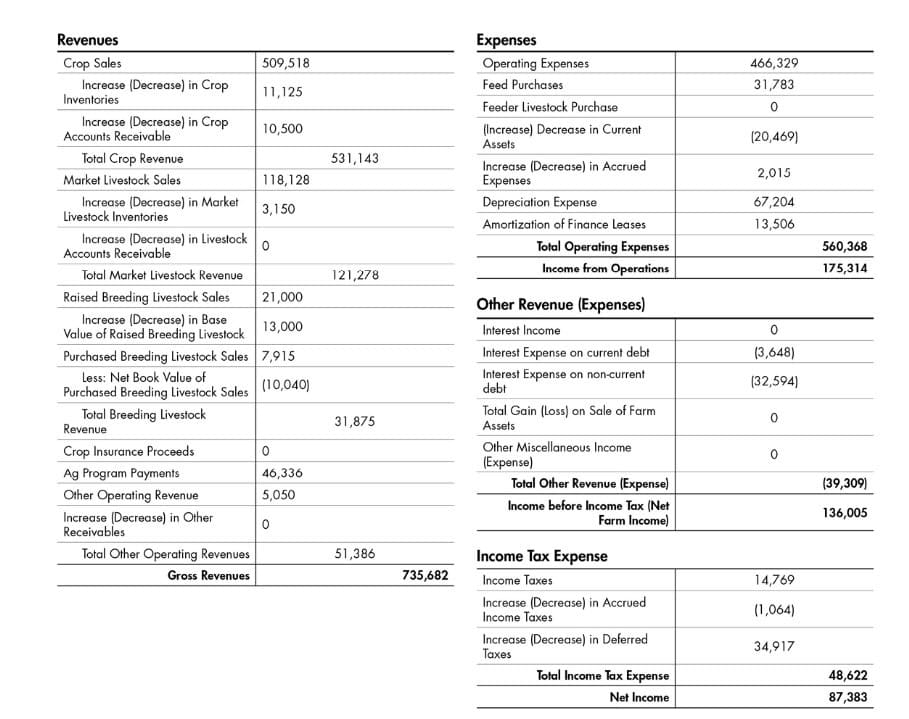
Example of an Income Statement, extension.msstate.edu
Mississippi State University Extension has resources available to walk through the pieces of an income statement.

